You’ve done two hours. Woods in the morning, ball in the park after work, a training session in the kitchen because somebody said mental stimulation tires them out. It’s nine o’clock and the dog is standing in the middle of the living room staring at you, or doing laps of the sofa, or chewing the corner of a cushion while making eye contact.
The instinctive conclusion is that he needs more. It’s almost always the opposite.
Dogs sleep far more than most owners think
An adult dog in a settled household sleeps somewhere between twelve and sixteen hours in a twenty-four hour period. Puppies and older dogs need more – eighteen to twenty hours is normal for a young pup, taken in a lot of short instalments rather than one long stretch.
Most owners, asked to guess, say eight. It’s a reasonable guess if you assume dogs run on the same clock we do. They don’t, and the gap between what people assume and what dogs actually need is the single most common cause of behaviour that gets described as hyperactivity.
An under-slept dog looks remarkably like an over-energetic one. He’s restless, he can’t settle, he’s snappy about things that wouldn’t normally bother him, he mouths, he starts things and abandons them. Anybody who has spent time with an overtired toddler will recognise the pattern immediately, and it’s the same problem: exhaustion presenting as mania rather than as sleepiness.
The mistake is that the behaviour reads as “needs another walk”, so the dog gets another walk, gets more stimulated, sleeps worse, and the whole thing tightens.
What over-arousal actually is
Arousal isn’t excitement, exactly. It’s the level of physiological activation – heart rate, adrenaline, cortisol, the whole system running hotter than baseline.
That’s fine and necessary in short bursts. The problem is the recovery time. After a properly exciting event, the hormones involved take hours to clear the system, and some of the stress markers take considerably longer than that. A dog who has a high-arousal experience every few hours never gets back down to baseline, and spends his life sitting at a level where everything is a bit much.
Once you see it that way, a lot of household behaviour makes more sense. The dog who’s fine on a Tuesday and impossible on a Saturday. The one who’s been getting steadily worse since you started doing the long weekend walks. The one who is perfectly pleasant on holiday in a quiet cottage and unbearable at home.
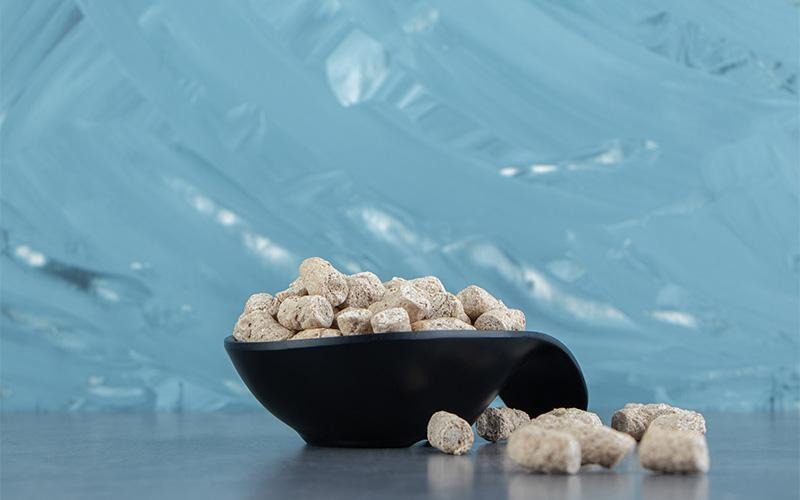
The fix is mostly about the shape of the day rather than the amount in it: fewer spikes, longer flat stretches, and deliberate periods where nothing at all is happening. Nutritional support has a place around the edges of that – Relaxing Dog Treats fed daily can take a little off the baseline while you sort the routine out – but the routine is the thing doing the work, and no supplement will outrun a schedule that winds a dog up four times a day.
The exercise trap
Here’s the bit that catches out the most conscientious owners.
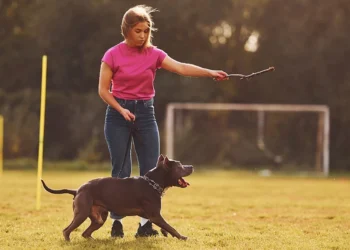
Repetitive, high-intensity exercise – ball chucker, flirt pole, endless fetch – is very arousing and very good at building fitness. Do it daily and you produce a dog who is both fitter and more practised at operating at a high arousal level. The distance required to tire him out goes up every month, and the ease with which he tips into frantic goes up with it.
There’s also a physical cost that’s easy to miss. Hard, repeated acceleration and braking on the same joints is a decent way to produce injuries in a young dog, and a fair amount of early arthritis in an older one.
None of this means don’t exercise your dog. It means the type matters more than the duration. A slow hour where the dog sets the pace and spends most of it with his nose down does more for his mental state than twenty minutes of flat-out fetch, and he’ll sleep better afterwards.
Sniffing is the underrated bit. It’s genuinely tiring, it lowers heart rate, and it’s the thing dogs would spend most of their time doing if left to organise their own day.
Trigger stacking
Behaviour rarely falls over because of one thing. It falls over because six small things happened and the sixth was one too many.
The postman at eight. A dog barking through the fence at nine. Somebody at the door at eleven. A hoover. The kids home at half three with two friends. And then, at six o’clock, you drop a spoon and the dog barks like the house is on fire, and it seems wildly out of proportion because you’re looking at the spoon rather than at the day.
Each of those events raised his arousal and none of them fully cleared before the next one arrived. He didn’t overreact to the spoon. He reacted to the accumulation, and the spoon was just the last item on the list.
This is why the same dog can handle something on one day and not on another, and why “but he’s normally fine with that” is such a common and misleading observation.
What it looks like
Some things worth watching for, because they’re easy to read as personality rather than as a state you can change.
Taking food roughly, when he can normally take it gently. Mouthing hands and sleeves. Zoomies at odd times, particularly in the evening. Barking at sounds he’d usually ignore. Struggling to lie down, or lying down and getting straight back up. Panting when it isn’t warm. An inability to disengage from something – the window, the fence, the spot where the cat was.
And sleep that’s broken and light rather than proper deep sleep. A dog who lifts his head every time somebody crosses the room isn’t really resting.
Audit the day
Write down everything that happens for two days. Every walk, every game, every visitor, every training session, every time the dog gets up to investigate something.
Most people are surprised. The gaps they thought were downtime turn out to be full of small events, and the dog turns out to be getting maybe two genuinely uninterrupted stretches in a fourteen-hour day.
Then start cutting. Not the walk – the twelve small stimulating things around it. Fewer games in the house. Less back-and-forth. A window film or a moved sofa if he spends the afternoon patrolling the front room. Something to stop the fence-line patrol if that’s a feature.
Enforced downtime
This is the intervention that produces the fastest change and the one owners resist hardest, because it feels like punishment.
A couple of times a day, the dog goes somewhere quiet – a crate with a blanket over it, a pen, a bed in a room with the door shut – with something to chew, for an hour or two. Not as a telling-off. Just as a scheduled part of the day, the way a nap is scheduled for a small child who has stopped being able to tell you they’re tired.
Most dogs protest for a few days and then start taking themselves off there. A lot of owners report that the dog is a different animal within a fortnight, and the usual reaction is mild embarrassment at how simple it turned out to be.
Chewing and licking are the right activities for this, because both are self-soothing and both actively lower arousal. A stuffed Kong, a lickimat, an appropriate long-lasting chew. Not a ball.
Teaching an off switch
Alongside all that, you can teach the behaviour directly, and the method is quieter than most training.
Watch for moments when the dog settles of his own accord and mark them. Not with a big fuss – that’ll get him up again. Just a calm word and a piece of food dropped between his paws while he stays lying down. You’re rewarding the state rather than an action.
Do that a few times a day for a couple of weeks and settling becomes something the dog does deliberately rather than something that occasionally happens to him. It’s slow and it’s dull and it works better than almost anything else on this list.
After a big day
If something genuinely exciting happens – a day at the beach, a house full of relatives, a long journey, a stay in kennels – expect a couple of days of decompression afterwards.
During that window the dog is likely to be more reactive, less tolerant and worse at settling, and the sensible response is a quiet couple of days rather than a big walk to work it off. Short lead walks somewhere familiar, plenty of sniffing, plenty of sleep, nothing new.
Owners who plan for that recovery period rather than being surprised by it tend to have a much easier time of it.
When it isn’t arousal at all
Worth ruling a few things out before you commit to six weeks of routine changes.
Pain is the big one. A dog who can’t get comfortable will get up and down, shift position, pace in the evening and sleep badly, and it reads almost identically to restlessness. Joint problems, back pain and dental pain are all easy to miss in a stoical dog, and the evening is when it tends to show because that’s when everything else has gone quiet.
Itching does something similar. A dog with an ongoing skin problem is being interrupted constantly, and constant interruption looks like an inability to settle.
In older dogs, night-time restlessness, pacing and disrupted sleep can be early canine cognitive dysfunction, which is worth catching early because there’s more that can be done for it than most owners realise.
And a dog whose appetite, drinking or toileting has changed alongside the restlessness needs a vet rather than a revised walking schedule. Any sudden onset in an adult dog who was previously settled deserves a proper look before you assume it’s behavioural.
How long it takes
Faster than most behaviour work. The sleep debt is often cleared inside a fortnight, and the difference in a dog who’s had two solid weeks of proper rest can be startling.
The arousal side takes longer, because you’re partly waiting for a habit to fade and partly building a new one. Give it six to eight weeks before you decide whether it’s working, and judge it on how quickly he settles after something exciting rather than on whether he gets excited at all. A dog who goes up and comes back down again in ten minutes is exactly what you’re aiming for.