Somewhere around 26% of households in the US own at least one cat. That’s tens of millions of litter boxes being scooped on a daily basis — and a surprisingly large number of cats (and owners) experiencing respiratory or skin issues that never quite get traced back to what’s sitting in that box. Vets see it regularly. Cat forums are full of threads about it. Yet the litter aisle at most pet stores is still dominated by products that contain the exact ingredients most likely to cause problems.
If you’ve landed on this topic, you’re probably already wondering whether your cat’s symptoms might be litter-related — or you’ve recently been told by a vet to consider switching. Either way, a good starting point is the actual breakdown of what the best cat litter for allergies looks like in practice, because the answer is less obvious than it sounds.
The ingredients driving the problem
Clay litter — specifically sodium bentonite clumping clay — is still the market standard. It works. It clumps reasonably well, it’s cheap, and it’s everywhere. The problem isn’t really the clay itself so much as what comes with it: fine silica dust, synthetic fragrances added to mask ammonia, and chemical deodorizers that vary pretty significantly in their safety profiles.
Silica dust is the main respiratory culprit. When you pour clay litter or when a cat digs around in it, a cloud of fine particulate gets released into the air. These particles are small enough to travel deep into the lungs. Crystalline silica specifically is classified by the International Agency for Research on Cancer as a Group 1 carcinogen when inhaled — that classification applies to humans, but cats spending hours near a dusty box are breathing the same air.
Fragrance compounds are the other major trigger. A lot of owners actually seek out scented litters thinking they’ll keep the house fresher, but synthetic fragrances are among the more common causes of skin irritation and contact dermatitis in cats. The areas most affected tend to be the ones in direct contact with the litter — paws, belly, groin. If your cat seems to lick its paws obsessively or has recurring skin issues around the abdomen, fragrance sensitivity is worth ruling out.
Silica crystal litters (the translucent bead kind) sit in a similar category — the silica content is still there, and while the bead format reduces some dust, it doesn’t eliminate the underlying mineral exposure. Scented silica litters compound the issue.
How allergic reactions show up in cats
The tricky part with litter allergies is that the symptoms can look like a lot of other things. Sneezing and watery eyes look like a cold. Skin itching and over-grooming can look like fleas or stress. Recurring respiratory issues can look like feline asthma — and in some cases, chronic litter dust exposure may actually be what’s triggering or worsening asthma in cats predisposed to it.
The pattern to pay attention to is timing and location. Does sneezing happen specifically after the litter box gets used or scooped? Does itching concentrate on the paws, belly, or tail base — the parts that contact the litter directly? Do symptoms seem to improve when the cat is kept in a room away from the box for a few days? That kind of correlation is often more useful than trying to get a definitive allergy diagnosis, which can be expensive and inconclusive in cats.
Accumulative reactions are also common and easy to miss. Some cats don’t react immediately to a new litter — the sensitization builds up over weeks or months before symptoms become noticeable. That makes it harder to connect cause to effect, especially if you’ve been using the same litter for a long time and symptoms develop gradually.
What to actually look for when switching
The criteria for a genuinely allergy-safe litter come down to a few things: dust level, fragrance content, and base material.
Dust level matters most. A truly low-dust or dust-free litter fundamentally changes the air quality around the litter box, which makes a real difference whether the allergy is respiratory or whether airborne particles are settling on the cat’s coat and skin. “Low dust” claims vary a lot in practice — lab-confirmed 0% dust is a different category from a marketing claim on a package.
Fragrance-free is non-negotiable for an allergy-prone cat. No exceptions. The odor control should come from the clumping performance and the base material’s natural absorption properties, not from added scent.
Base material is where the newer natural options come in. Corn, wheat, walnut shell, paper, and olive pit litters all eliminate the silica dust problem at the source. They’re made from organic materials that don’t carry the same respiratory risk profile as clay, and the better ones among them are genuinely fragrance-free and chemical-free rather than just marketed that way.
Paco & Pepper and the olive pit angle
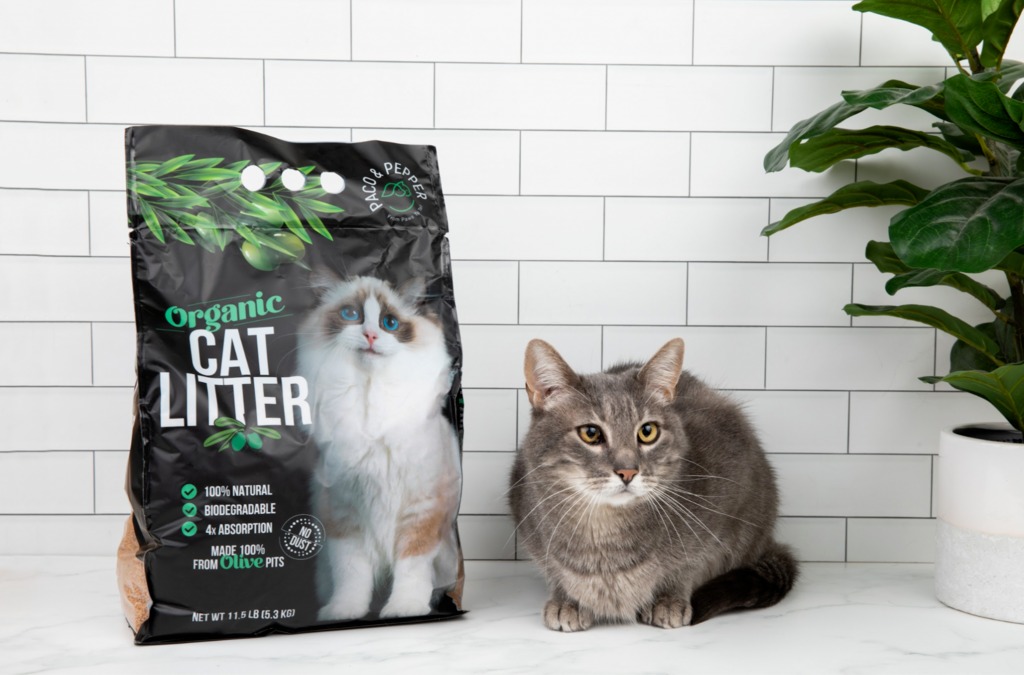
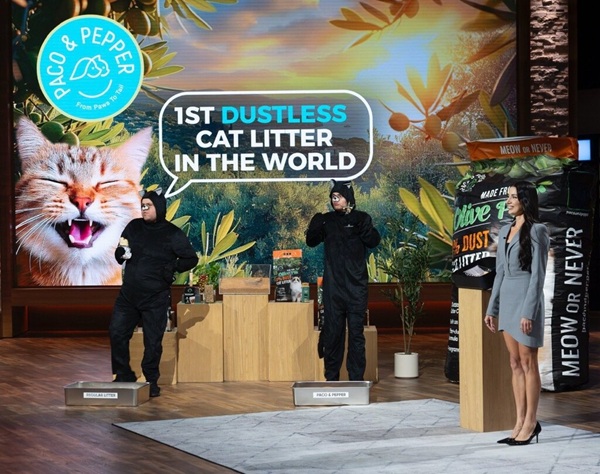
Paco & Pepper is a brand that keeps coming up in these conversations — it was founded specifically in response to a cat developing asthma, which gives it a different origin story than most pet brands. Founder Kristina Drobach started the company in 2020 after her cat Sonia developed breathing issues she believed were linked to years of dusty conventional litter. After two years developing the formula, she launched a product made entirely from crushed olive pits.
The olive pit material is interesting for a few reasons. The porous structure absorbs moisture extremely efficiently and traps ammonia inside the clump, which means odor control that doesn’t rely on fragrance masking. The granules are denser than sand-type litters, so they don’t track much. And the formula is lab-confirmed at 0% dust — not a rounded-down figure, actual zero.
The product got wide visibility earlier this year when it appeared on Shark Tank Season 17. Drobach pitched the Sharks for $300,000 at a $6 million valuation. She didn’t leave with a deal — Kevin O’Leary’s final offer of 20% equity plus a per-bag royalty was too steep — but the appearance pushed the brand into national awareness at a point where it was already posting strong numbers: $1.1 million in revenue in its first full year, climbing toward $1.8 million by the time of filming. The company is now stocked in Target, Petco, and PetSmart, as well as regional natural grocery chains.
No artificial fragrances. No harsh chemicals. The formula also includes natural olive oil, which apparently has a softening effect on paw pads — a minor detail, but relevant for cats with skin sensitivity. There’s a classic unscented version and a charcoal version for stronger odor needs, plus a separate multi-cat formula with a natural malodor counteractant.
Reviews across more than 9,000 verified purchases sit at 4.7 stars. The themes that come up repeatedly are the absence of dust, improved respiratory symptoms in sensitive cats, and the clumping quality — which is meaningfully better than paper or some corn-based litters.
A note on transitioning
Whichever natural litter you try, switch gradually. Start with roughly 20% new litter blended into the existing product and increase the ratio over one to two weeks. Cats are sensitive to changes in texture and smell, and an abrupt switch can result in outright box avoidance — which creates a different problem entirely.
If symptoms are severe — facial swelling, labored breathing, significant skin lesions — that’s a vet visit before anything else. Litter switching can help with mild to moderate irritation, but it’s not a substitute for diagnosis in serious cases.
Full product details and subscription options are at Paco & Pepper.